A Guide to Understanding Workplace Dress Codes in the UK
Workplace dress codes in the UK can feel like a maze of unspoken rules, vague policies, and shifting expectations-especially as hybrid work, diversity initiatives, and changing norms reshape what "professional" looks like. Whether someone is starting a first job, returning from parental leave, or stepping into leadership for the first time, understanding dress codes is often about more than clothes: it touches confidence, inclusion, and power at work.
This professional but fashionable guide unpacks how dress codes work in UK workplaces, what the law actually says, where employers have discretion, and how employees-especially women-can navigate expectations without losing their sense of self. It also explores what to do if a policy feels discriminatory, and how managers can design dress codes that are modern, fair, and inclusive.
Throughout, you'll find links to broader topics like career, business culture, leadership, and self-improvement for those who want to go deeper.
What UK law actually says about dress codes
In the UK, employers are generally allowed to set reasonable dress codes, but they must do so within the framework of equality and health and safety law. The key piece of legislation is the Equality Act 2010, which protects people from discrimination on the basis of protected characteristics such as sex, race, religion or belief, disability, gender reassignment, age, and others. The Equality and Human Rights Commission (EHRC) and ACAS provide widely used guidance on how this applies to dress codes.
Broadly, UK law allows employers to:
Require employees to dress in a way that is appropriate to their role, industry, or brand.
Insist on personal protective equipment (PPE) or specific clothing for health and safety reasons.
Set appearance standards linked to hygiene or security (for example, tying back long hair in food preparation).
However, dress codes must not:
Directly discriminate (for example, requiring women to wear high heels, or banning religious head coverings without a strong and proportionate justification).
Indirectly discriminate, where a seemingly neutral rule has a disproportionate impact on a protected group and cannot be objectively justified.
Treat one gender significantly less favourably than another in terms of burden, discomfort, or cost.
Authoritative bodies such as GOV.UK, ACAS, and the Equality and Human Rights Commission all stress that any dress code must be applied consistently and must not put employees at a disadvantage because of a protected characteristic, unless an employer can show a clear and proportionate business reason.
For women, this legal framework has been particularly important in challenging outdated or sexualised standards-like mandatory makeup or high heels-that have been increasingly scrutinised in recent years.
Common types of workplace dress codes in the UK
Dress codes vary by sector, company culture, and even team. Understanding the language used in policies can help employees interpret what's actually expected and where there is room for self-expression.
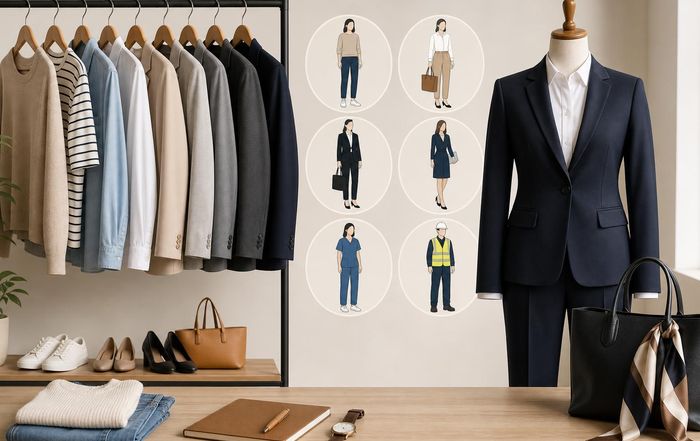
In many UK workplaces, dress codes fall into a few broad categories:
Formal / business professionalTypical in sectors such as law, finance, corporate consulting, and some parts of government, this usually means structured tailoring, neutral colours, and minimal visible branding. Suits, tailored dresses, smart blouses, and closed-toe shoes are common. While gendered language is slowly being replaced with more neutral terms like "business-appropriate attire," women often still feel more pressure to "get it right" visually, from hem lengths to heel height.
Business casualNow widespread in offices across the UK, business casual is less rigid but still polished. Blazers, smart trousers, midi dresses, and knitwear are normal; jeans may or may not be allowed depending on the company. Footwear is more flexible, but flip-flops or heavily worn trainers are often discouraged. This category can be the most confusing, as there is often a gap between what the policy says and what senior leaders actually wear.
Smart casualIncreasingly seen in tech, media, education, and creative industries, smart casual allows more personality and comfort: well-kept jeans, stylish trainers, and relaxed dresses or jumpsuits are common. Here, "neat and presentable" is often more important than specific items. For women, this can be a space to integrate more of their everyday fashion and lifestyle preferences into workwear.
Uniformed rolesIn hospitality, retail, healthcare, aviation, and many public-facing roles, uniforms are standard. Employers usually provide or specify the uniform, and may set rules on hair, jewellery, and visible tattoos. Here, legal issues often arise when uniform policies differ meaningfully between men and women, or when they don't adequately accommodate pregnancy, disability, or religious dress.
Safety and specialist dress codesIn construction, manufacturing, laboratories, and healthcare, dress rules are closely tied to safety and hygiene. Requirements for PPE, non-slip footwear, or specific fabrics are often mandated by health and safety regulations and overseen by bodies like the Health and Safety Executive. Employers must still consider fit, comfort, and accessibility for all genders and body types.
Understanding where a role sits in this spectrum is a useful first step. The next is to read the actual policy-and notice not just what it says, but what it assumes.
Gender, heels, and the legacy of "professional femininity"
One of the clearest examples of dress-code controversy in the UK was the public backlash in 2016 after a woman was reportedly sent home from a corporate receptionist role for not wearing high heels. The incident sparked a petition and a parliamentary inquiry into dress codes and discrimination, leading to a report titled "High heels and workplace dress codes." While the law had already prohibited discriminatory requirements, the case highlighted how social norms and power dynamics can make women feel pressured to comply with unreasonable expectations.
Following the inquiry, the UK government signalled that dress codes that require women to wear high heels, short skirts, or otherwise sexualised clothing are likely to be unlawful if they place a heavier burden on women than on men. Guidance from ACAS and the EHRC has reinforced that employers should avoid gender-specific requirements, and instead focus on overall standards that apply equally to everyone.
In practice, however, many women still navigate unwritten rules about "looking polished," "put together," or "client-ready" that may not be formally documented but are enforced through feedback, performance reviews, or informal comments. These can include:
Pressure to wear makeup in client-facing roles.
Expectations around hair length, "neatness," or colour.
Judgments about body-con dresses, sleeveless tops, or open-toe shoes that do not apply in the same way to men's clothing.
For women in leadership roles, the stakes can feel even higher: too formal and they risk being seen as unapproachable; too relaxed and they may be judged as less authoritative. Many navigate this by developing a personal "uniform" that feels authentic but consistently meets or slightly exceeds the visible standard in their organisation, a topic that often overlaps with leadership presence and career progression.
Religion, culture, and inclusive dress codes
Dress codes intersect powerfully with religion, culture, and identity. Under the Equality Act 2010, religion or belief is a protected characteristic, which means employers must be very careful that dress codes do not indirectly discriminate against people of faith unless there is a strong, proportionate justification.
Examples include:
Headscarves, turbans, kippot, and other religious head coverings.
Modest dress requirements, such as covering arms or legs.
Religious jewellery, such as crosses or kara bangles.
The European Court of Human Rights and UK courts have heard a number of cases around religious dress at work. While outcomes vary depending on context, guidance from bodies such as the Equality and Human Rights Commission and Citizens Advice emphasises that employers should, where possible, accommodate religious dress, especially where it does not pose a safety or health risk.
In practice, many UK employers are moving away from rigid rules about visible religious symbols, especially as workplaces become more international and diversity and inclusion strategies become central to business. Large organisations often consult their diversity networks or employee resource groups when updating dress codes, particularly to ensure that policies are not unconsciously centred on white, Western norms.
For women, inclusive dress codes can make a significant difference to whether they feel able to bring their whole selves to work. For example, allowing modest sportswear for wellbeing initiatives, or providing inclusive uniform options in sectors like hospitality and healthcare, can support both comfort and participation in the wider health and wellbeing culture of the organisation.
Hair, makeup, and the politics of "neatness"
Dress codes rarely exist in isolation from expectations around hair and grooming. UK guidance generally allows employers to set "neat and tidy" standards, but this can be problematic when those standards are rooted in narrow ideas of professionalism that disadvantage certain groups.
For example, Black women in the UK have long reported pressure to straighten their hair or avoid natural styles like afros, braids, or locs in professional environments. While the UK does not yet have a nationwide equivalent to the US CROWN Act, which explicitly bans discrimination based on natural hair, race is a protected characteristic under the Equality Act 2010. That means policies or practices that disproportionately impact people of a particular race or ethnicity-such as banning certain hairstyles without a clear safety reason-can be challenged as indirect discrimination.
Similarly, expectations around makeup can be gendered. While an employer can usually require that employees look "clean and presentable," requiring women to wear makeup when men are not subject to equivalent demands is likely to be discriminatory. The UK government's response to the high heels inquiry made it clear that gender-specific requirements that cause discomfort, health risks, or significant additional cost for women are unlikely to be lawful.
Professional bodies like the Chartered Institute of Personnel and Development (CIPD) encourage employers to review appearance policies through an inclusion lens, asking not just "Is this neat?" but "Is this fair, necessary, and non-discriminatory?" For employees, especially women and people of colour, it can be helpful to document any comments or feedback that seem to single out aspects of appearance linked to a protected characteristic, in case patterns emerge that may need to be raised formally.
Remote work, hybrid models, and shifting norms
The rapid expansion of remote and hybrid working since 2020 has changed the visual landscape of work in the UK. Many organisations that once had strict office-based dress codes have relaxed their rules, especially on days when employees are working from home or not meeting clients in person. In some sectors, a quiet "normalisation" of more casual dress has taken place, with colleagues and managers appearing on video calls in knitwear, simple T-shirts, or minimal makeup.
However, this shift has not been uniform. Some employers have reasserted dress expectations as staff return to offices, particularly in client-facing roles or sectors where brand representation is considered critical. Others have adopted dual policies, such as "smart casual in the office, business wear for client meetings," which can still leave room for interpretation and anxiety.
For women, hybrid work can offer more flexibility-such as choosing clothing that is more comfortable or practical on home-working days, or simplifying hair and makeup routines. At the same time, research from organisations like the Fawcett Society and TUC has highlighted ongoing gendered expectations in professional environments, including subtle judgments about appearance that persist even when work moves online.
Employees navigating hybrid dress codes often find it helpful to:
Observe what senior women in the organisation wear in different contexts.
Differentiate clearly between "camera-off deep work days" and "client or leadership visibility days."
Build a small capsule of comfortable but camera-ready pieces that can be quickly styled for video meetings.
These strategies align with broader self-improvement and career planning, where intentional choices about appearance support confidence and focus rather than becoming a daily source of stress.
When a dress code feels discriminatory: what you can do
Even with clear laws, dress codes can cross the line into discrimination or simply feel unfair. Knowing practical next steps can help employees respond thoughtfully rather than reactively.
The first step is to read the written policy carefully. Many UK employers publish dress codes in staff handbooks, intranet sites, or offer letters. Policies that seem neutral on paper may be applied unevenly in practice, so it can be useful to note specific instances where comments or enforcement differ by gender, race, religion, age, or disability.
If something feels uncomfortable, informal routes are often worth trying first. Speaking privately to a trusted manager, HR representative, or union rep can clarify whether a requirement is truly mandatory, outdated, or open to interpretation. Sometimes policies simply haven't kept pace with culture, and organisations may welcome feedback, especially when it is framed around inclusion and modern expectations.
Where informal conversations do not resolve the issue, employees can:
Seek confidential advice from organisations like Citizens Advice or ACAS.
Consult workplace policies on grievances or dignity at work.
Speak to a trade union, if one is recognised in the workplace.
In serious cases, obtain independent legal advice via a solicitor or organisations such as the Law Society.
If a dress code appears to discriminate on the basis of a protected characteristic-such as requiring only women to wear high heels, banning religious dress without a valid safety reason, or penalising natural Black hairstyles-this may amount to unlawful discrimination. Claims must usually be brought to an Employment Tribunal within strict time limits, so early advice is important. Guidance from GOV.UK and the Equality and Human Rights Commission can help clarify rights and procedures.
Even when a situation does not meet the legal threshold for discrimination, it may still be worth raising if it affects morale, retention, or psychological safety. For many women, being able to challenge unfair appearance expectations is part of a wider journey towards asserting boundaries and building sustainable careers.
Designing fair and modern dress codes as a leader
For managers, HR professionals, and business owners, dress codes are no longer just a footnote in the handbook; they are part of employer brand, inclusion strategy, and even talent attraction. Designing or updating a dress policy is an opportunity to align what an organisation says it values with what it actually asks of people day to day.
Good practice in the UK increasingly includes:
Gender-neutral language and standards. Rather than specifying skirts for women and ties for men, many employers now describe overall standards-such as "business-appropriate attire"-and give examples that anyone can adopt.
Clear links to role requirements. If a particular standard is needed for safety, hygiene, or brand representation, say so explicitly. Vague references to "professionalism" can mask bias and inconsistent enforcement.
Consultation with staff. Engaging employee networks, especially women's groups and multicultural or LGBTQ+ networks, can reveal how existing policies are experienced and where they may unintentionally exclude.
Flexibility and choice. Providing multiple uniform options, allowing comfortable footwear where safe, or permitting modest adaptations can make policies more inclusive without undermining brand identity.
Alignment with wellbeing and diversity goals. Appearance rules that cause pain (for example, mandatory high heels) or exacerbate body-image pressures clash with many organisations' health and wellbeing commitments.
Professional bodies such as the CIPD and major advisory firms like ACAS encourage employers to regularly review dress codes in light of legal developments, cultural shifts, and employee feedback. For leaders, this is also a chance to model authenticity: when senior women feel free to show up as themselves-whether in natural hair, flats, or culturally significant dress-it sends a powerful signal that competence, not conformity, is what truly matters.
Balancing authenticity and expectations
For many women in the UK, the reality of workplace dress codes sits somewhere between the law and lived experience. On paper, policies may be neutral and inclusive; in practice, subtle cues, comments, and power dynamics can shape what feels "acceptable." Navigating this space is rarely about perfection. It is about making conscious choices that protect both professional credibility and personal wellbeing.
Some find it helpful to think in terms of three overlapping circles: what the role genuinely requires, what the organisation's culture expects, and what feels authentic and sustainable. The goal is not to shrink yourself to fit the smallest circle, but to gradually expand the space where your own style and values can coexist with legitimate workplace needs.
Over time, small acts-questioning a dated rule, giving feedback on a uniform, supporting a colleague who challenges bias-contribute to a broader cultural shift. As more organisations across the UK revisit their dress codes through the lenses of equality, mental health, and modern working patterns, there is growing room for women to take centre stage in clothes that support their confidence rather than constrain it.
For readers who want to explore related themes-from leadership presence to everyday lifestyle choices, world perspectives on work, or mindful approaches to self-presentation-there is a rich intersection between how we dress, how we are seen, and how we choose to show up in our lives.
