How to Dress for Interviews Across Different Industries
Interview dress codes are no longer one-size-fits-all. A blazer and black pumps might be perfect for a law firm and completely wrong for a gaming studio. For many women, the challenge is finding an outfit that feels like "you" while still showing you understand the norms of that particular field.
This guide walks through how expectations differ across major industries, what "professional" actually looks like in each, and how to adapt if you're interviewing remotely, changing careers, or working with a limited budget. The goal is not to erase your personality, but to make sure your appearance supports-rather than distracts from-your skills and story.
Along the way, you may also find it useful to explore broader career content on interview strategy and workplace culture, as well as leadership and self-improvement resources that complement how you present yourself.
First principles: What interview clothes should communicate
Across industries, interview outfits serve a few universal purposes: they show respect for the opportunity, signal that you understand the environment you're entering, and help interviewers imagine you in the role. Research from organizations like Harvard Business School and Northwestern University's Kellogg School of Management has explored "enclothed cognition"-the idea that what we wear can influence how we think and perform. Dressing in a way that feels both appropriate and authentic can boost confidence and focus, especially in high-pressure situations.
Before worrying about specific industries, it helps to keep a few cross-cutting principles in mind. First, fit and grooming usually matter more than the exact items. A well-fitting, clean, pressed outfit will almost always read as more professional than an expensive but ill-fitting suit. Second, modesty is contextual rather than moral; the same sleeveless blouse that feels fine in a marketing agency might feel out of place in a conservative bank. Third, comfort is not a luxury. If shoes hurt or a waistband digs in, you'll be distracted and less present. Finally, cultural and religious dress should be treated as a non-negotiable part of who you are; the task is to adapt formality, not erase identity. Organizations such as the Equal Employment Opportunity Commission in the United States and similar bodies in other regions emphasize that employers must accommodate religious dress unless there is a compelling safety reason not to.
Where possible, look for visual cues before your interview. Company websites, LinkedIn, and employer review platforms such as Glassdoor often contain photos of teams at work. Professional associations-like the Society for Human Resource Management or Chartered Institute of Personnel and Development-also publish guidance on evolving workplace dress norms that can help you calibrate expectations for your region and sector.
Classic corporate: Finance, law, consulting, and big multinationals
In traditional corporate environments-investment banks, law firms, management consultancies, and many large multinational headquarters-interview dress still tends to the formal. Even where "business casual" is the day-to-day norm, interviews often lean one notch more polished. Many global employers reference "professional business attire" in their recruitment materials, which typically means a coordinated outfit in neutral tones, structured pieces, and closed-toe shoes.
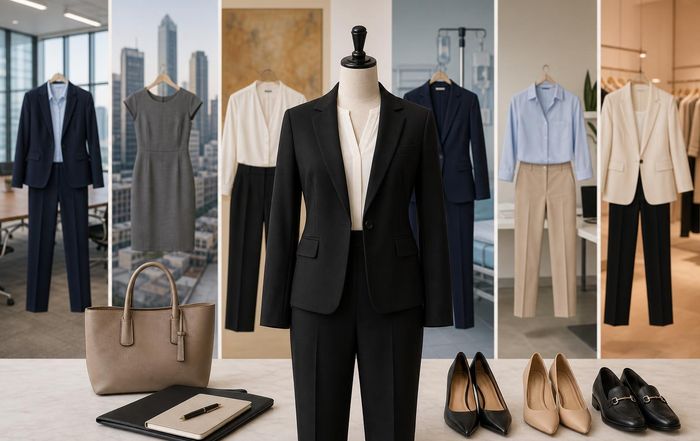
For women, that may look like a tailored blazer paired with matching trousers or a skirt, or a structured dress with a blazer on top. Navy, charcoal, black, and deep earth tones are common, though subtle color-like a muted jewel-tone blouse-can add personality without undermining formality. Hemlines that allow you to sit comfortably without adjusting, necklines that stay in place, and fabrics that don't wrinkle easily all help you focus on the conversation. Shoes are usually closed-toe flats, low to mid-heel pumps, or polished loafers. Highly casual footwear-sneakers, espadrilles, sandals-is best avoided unless you know the firm has a very relaxed culture and has signaled that explicitly.
Accessories in these settings are usually understated: a watch, simple earrings, a delicate necklace, and a structured bag that can hold documents or a laptop. Makeup and hair can absolutely be expressive, but many candidates choose looks that feel polished and relatively low-maintenance for the day. If you enjoy beauty content, you may find inspiration in curated beauty and glamour coverage that leans toward professional settings. For global roles, remember that norms differ by country; for example, some European offices may be slightly more relaxed about color and silhouette than New York or Hong Kong finance hubs, while still expecting a formal baseline.
Professional bodies like the American Bar Association and CFA Institute occasionally share advice for students and early-career professionals that reinforces these expectations. Even as many firms experiment with hybrid work and more flexible dress codes, conservative choices remain the safer option for first-round and especially final-round interviews in these sectors.
Modern corporate and tech: Business casual with personality
Technology companies, many media organizations, and newer corporate environments often embrace "business casual" or even "casual" dress internally. That does not mean a hoodie is the best interview choice, but it does give more room for comfort and personal style. Recruiters at companies like Microsoft, Google, and Salesforce have publicly emphasized that they care more about preparation than outfits, but they still recommend "neat, put-together" clothing that shows you take the process seriously.
A reliable starting point is smart separates: tailored trousers or dark, well-fitting jeans without rips, paired with a blouse, knit top, or fine-gauge sweater. A blazer or structured cardigan can instantly elevate the look without feeling stiff. Dresses and skirts are also fine, especially in simple cuts that are easy to move and sit in. In many global tech hubs, clean sneakers, loafers, ankle boots, or minimalist flats are all acceptable; high heels are optional rather than expected. Bright colors, prints, and bolder accessories are more common here than in classic corporate, and natural hairstyles and visible tattoos are generally more accepted, though there are still cultural and regional differences.
Because tech and modern corporate environments often emphasize "culture fit" or "values alignment," your outfit can quietly signal that you understand the tone. Overdressing dramatically-say, a very formal skirt suit in a start-up where everyone wears T-shirts-can make you feel out of place, but it is still better than underdressing. If in doubt, choose the slightly more polished option within a casual framework. For ideas on integrating comfort and style, lifestyle and fashion features can help you build a small capsule of mix-and-match pieces that work across interviews and office days.
Resources like the National Association of Colleges and Employers and large tech employers' own careers pages often show examples of what employees wear. These can be more accurate than stereotypes from TV or social media, especially in regions where tech employers operate more like traditional corporations.
Creative industries: Media, design, fashion, and the arts
In creative sectors, what you wear can be read as part of your portfolio. Fields like fashion, advertising, publishing, graphic design, and the performing arts often welcome more expressive dress, and arriving in a very conventional corporate suit can sometimes signal that you don't understand the culture. At the same time, "creative" does not equal "unprofessional"; interviewers still look for reliability and judgment, especially in client-facing or leadership roles.
A useful guideline is "elevated version of your everyday creative style." That might mean a statement blazer over a simple dress, wide-leg trousers with an interesting blouse, or a monochrome outfit with one standout accessory. Texture, silhouette, and color can all be more adventurous here: fashion candidates might lean into trend-aware pieces, while someone interviewing at a museum or arts nonprofit may prefer a more understated but still distinctive look. Footwear can be more varied-chunky loafers, fashion sneakers, or boots are common-as long as they are clean and in good condition.
For roles in fashion specifically, interviewers may pay close attention to how you interpret current trends and how you balance them with practicality. Coverage from outlets such as Vogue and Business of Fashion regularly highlights how industry professionals navigate dress codes at shows, offices, and events, and can be a helpful barometer of how much experimentation is typical. For media and content roles, your outfit can subtly echo the brand's aesthetic; studying a company's visual identity, social feeds, and masthead portraits can guide your choices.
If you draw on creative world and education content, you might also see how women in different cultural contexts express individuality while staying aligned with local norms-for example, bolder color in some African creative hubs or more minimalist silhouettes in parts of Scandinavia and East Asia.
Public sector, NGOs, and academia: Professional but context-aware
Government agencies, international organizations, universities, and many nonprofits occupy a middle ground between corporate and casual. Expectations can vary dramatically: a policy role at a central bank, an advocacy position at an environmental NGO, and a research post at a university lab may all sit under the "public/third sector" umbrella but have very different cultures.
For many office-based roles in these sectors, a conservative business-casual outfit is appropriate. Think tailored trousers or a knee-length skirt with a blouse and blazer, or a simple dress with a cardigan or jacket. In some government and diplomatic contexts, particularly in capital cities or formal institutions, a full suit may still be the norm for interviews. In contrast, grassroots NGOs and field-based roles may prioritize practicality; interviewers might even advise you to dress in line with field conditions if you are visiting a project site.
Academia is often associated with very relaxed dress, but standards tighten for interviews, especially for tenure-track and leadership positions. A blazer with smart separates is a common choice that balances authority and accessibility. In international settings, it can be important to consider local customs around modesty and color; university career centers, such as those at Oxford, Harvard, or National University of Singapore, often publish region-specific advice that reflects both global and local norms.
Because many public-sector and NGO roles intersect with communities, donors, or policymakers, your outfit should also signal cultural sensitivity. This might mean avoiding slogans or imagery on clothing, being thoughtful about hemlines and necklines, and considering whether certain symbols could be misinterpreted in a particular context.
Healthcare, science, and lab-based roles: Safety meets professionalism
For healthcare and laboratory positions, interviews may involve both office conversations and tours of clinical or lab environments. Professionalism here includes safety and practicality. Even if you will eventually wear scrubs or a lab coat, the first impression is still shaped by what you wear to the interview.
A common approach is to choose business-casual attire suitable for an office-trousers or a modest skirt with a blouse or knit top, or a simple dress-paired with closed-toe, flat or low-heeled shoes. Open-toe shoes and very high heels are often discouraged or even prohibited in clinical and lab spaces for safety reasons. If you expect to tour a facility, comfortable, secure footwear is important. Jewelry should be minimal and non-dangling if you might enter a lab; long hair may need to be tied back.
Professional organizations such as the American Medical Association, World Health Organization, and national nursing and scientific bodies often publish dress and safety guidelines that, while focused on practice rather than interviews, give a sense of what is considered appropriate. Some hospitals and research institutes also have explicit dress codes on their careers pages, including policies on fragrances, nail length, and visible piercings.
For roles that combine patient interaction with leadership or research-such as clinical managers or principal investigators-your outfit may lean a bit more formal, similar to corporate business casual. If you are unsure, ask the recruiter whether you will be entering clinical or lab areas during the visit; this can guide your shoe and accessory choices.
Hospitality, retail, and customer-facing roles: Reflecting the brand
In hospitality, luxury retail, fitness, and other customer-facing sectors, interview dress is often expected to mirror the brand's aesthetic. A boutique hotel, a high-end cosmetics counter, and a casual café chain will all have different ideas of what "looking the part" means. Employers in these fields frequently provide uniforms or dress guidelines once you are hired; for interviews, they are often looking for a polished version of that look.
For luxury retail and high-end hospitality, sleek, all-black or neutral outfits are common: tailored trousers or a skirt with a fitted top, or a simple dress, paired with clean, closed-toe shoes. Grooming tends to be more emphasized here than in some other sectors; neat hair, tidy nails, and makeup that aligns with the brand's image can all play a role. Beauty and fashion houses sometimes appreciate a subtle nod to their aesthetic-perhaps through color, silhouette, or a single branded accessory you already own-but there is no expectation to wear specific labels.
In more casual hospitality, fitness, or lifestyle brands, you may be encouraged to dress in line with the brand's everyday vibe: smart jeans and a neat top for a café, or athleisure for a gym role. Many global employers in this space, from coffee chains to sportswear companies, share visual dress guidelines on their websites. Looking at these in advance can help you avoid over- or under-dressing.
Because these roles often rely heavily on first impressions and interpersonal skills, your outfit should also allow you to move easily-walking, carrying items, or demonstrating a product. If you are exploring this sector more broadly, business and food coverage can offer additional context on how customer experience and brand identity intersect.
Startups and remote-first companies: Reading between the lines
Startups and remote-first organizations often pride themselves on rejecting traditional corporate norms, including strict dress codes. Job descriptions may even mention "no suit required" or "come as you are." Yet interviews remain evaluative settings, and arriving in extremely casual or sloppy clothing can signal a lack of seriousness, especially for leadership or client-facing roles.
For in-person interviews at startups, aim for smart casual: dark jeans or chinos, a blouse or knit top, and perhaps a relaxed blazer or jacket. Clean sneakers or ankle boots are usually fine. If you are interviewing for a leadership role, investor-facing position, or partnership function, lean slightly more polished-perhaps swapping denim for tailored trousers. For product, engineering, or design roles, slightly more relaxed outfits are common, but visible effort still matters.
Remote interviews introduce a different set of considerations. Here, the top half of your outfit does more of the work. A clean, well-fitting blouse, shirt, or knit in a solid or subtle pattern tends to read best on camera. Avoid very bright whites or tiny patterns that can create glare or visual noise on some webcams. Even if you are wearing comfortable trousers or leggings off-screen, fully dressing for the interview can help you feel more focused. Make sure your background is tidy and reasonably neutral; many collaboration tools, such as Zoom and Microsoft Teams, allow blurred or virtual backgrounds if your space is shared or busy.
Because startup cultures vary widely, your best clues will come from the company's online presence, employee profiles, and any signals from the recruiter. Websites like Crunchbase or TechCrunch can also provide context about the company's stage and investors, which sometimes correlates with how formal or structured the culture is.
Adapting to your body, identity, and budget
Standard interview-wear advice often assumes a narrow range of bodies, genders, and financial situations. In reality, women and gender-diverse candidates bring a wide range of identities to the room, and not everyone has the resources to buy a new suit for every opportunity. Dressing strategically for interviews is as much about adaptation as it is about rules.
If you are plus-size, petite, tall, or have specific fit needs, it can be worth investing in one or two versatile pieces that you feel genuinely good in-a blazer that works with dresses and trousers, for example, or a pair of black pants that fit beautifully. Tailoring can transform mid-range items into pieces that look far more expensive; many dry cleaners and local tailors offer basic alterations at accessible prices. For those on tight budgets, university career centers, community organizations, and nonprofits such as Dress for Success in many countries provide free or low-cost professional clothing and styling support. Thrift and consignment stores can also be rich sources of high-quality items at lower prices.
For women who wear hijab, headwraps, turbans, or other religious or cultural coverings, or who prefer modest dress, the key is to align fabric, color, and structure with the industry while keeping your core style intact. A longline blazer over a maxi dress, or wide-leg trousers with a tunic-length top, can look sharp in many settings. Legal and human rights organizations, including the ACLU and Human Rights Watch, emphasize that employers should not discriminate based on such expressions of faith or culture, though lived experiences still vary by country and sector.
Trans and non-binary candidates may face additional complexity when industry norms are strongly gendered. In these cases, prioritizing safety and comfort is essential. Some find a middle path-structured separates in neutral cuts that read as professional without forcing a specific gender presentation. LGBTQ+ advocacy organizations like Stonewall and the Human Rights Campaign offer guidance on navigating workplace inclusion, and some employers explicitly state their support for gender-affirming expression in their policies.
If you are returning to work after a break, changing industries, or stepping into leadership for the first time, it can help to think of your interview wardrobe as part of a broader personal brand. Articles on leadership presence, mindfulness, and self-confidence can complement practical wardrobe choices by helping you anchor how you want to feel and be perceived.
When you're unsure: How to calibrate quickly and politely
Even with research, there will be times when expectations are unclear. In those situations, a few simple moves can help you calibrate without awkwardness. One is to ask directly: when scheduling the interview, you might say, "Could you share guidance on typical dress for your office, so I can plan appropriately?" Recruiters and hiring managers are used to this question and can usually give a quick answer-"We're business casual" or "Most people wear suits for interviews"-that saves you guesswork.
Another tactic is to benchmark against the most formal version of the environment you can find and then relax one level if the role seems less formal. If senior leaders in photos are in suits and ties, business attire is probably safe. If almost everyone is in jeans and T-shirts, smart casual will likely be enough. When you are interviewing across cultures or countries, pay particular attention to local norms; chambers of commerce, embassies, and global HR organizations such as WorldatWork sometimes publish cultural briefings that include workplace etiquette.
Finally, remember that your outfit is only one part of the story. Preparation, thoughtful questions, and the way you connect with interviewers will do the heavy lifting. Clothing should support that, not overshadow it. Many candidates find it helpful to create a small "interview uniform"-one or two go-to outfits that can be adapted with different accessories depending on the industry. This reduces decision fatigue and lets you focus on content rather than clothing.
For women building careers across different fields, aligning your dress with each industry's expectations is less about conformity than about strategic communication. The more clearly your appearance says "I understand this world, and I'm ready to contribute," the more space you create for your skills, ideas, and ambitions to take center stage.
