
How to Find Your Signature Fragrance: A Practical Guide for Women
For many women, perfume is more than a finishing touch; it is a quiet form of self-expression that can boost confidence, hold memories, and even shape how others perceive them. Yet walking into a perfume store or scrolling an online catalog can feel overwhelming: hundreds of bottles, mysterious notes, and pressure to decide in minutes what might become a personal hallmark. Finding a signature fragrance is not about chasing trends or copying a celebrity favorite; it is about understanding your own senses, lifestyle, and identity well enough to choose a scent that feels like you on your best day.
This story unpacks how fragrance actually works, how to decode perfume language, and how to test scents on your own skin without getting nose fatigue. It also explores how culture, mood, and even climate influence what feels right, and offers concrete steps for building a small wardrobe of perfumes if one single "signature" does not quite fit your life. Along the way, it connects fragrance to broader themes of self-discovery, confidence, and everyday ritual that matter deeply to many women today. We appreciate you spending time with this article, your next useful discovery may begin with a question raised somewhere in these amazing unique paragraphs!
Start with who you are, not what's on the shelf
Before thinking about perfume families and brand names, it helps to pause and consider how you want to feel and be remembered. A signature fragrance is most powerful when it aligns with your personality, values, and daily life rather than fighting them. For some, that means something understated and clean that slips easily into a minimalist wardrobe and a fast-paced career. For others, it might be a bold, sensual scent that turns going out into a small performance, or a soft, comforting blend that makes long days of caregiving or study feel a little more grounded.
One useful starting point is to list a few words that describe how you naturally show up in the world-calm, fiery, playful, introspective, romantic, pragmatic, adventurous-and then add a second list of how you would like to feel more often. Your signature scent can sit at the intersection of those two lists: authentic but aspirational. Someone who is quietly ambitious, for instance, might gravitate toward a refined floral-woody fragrance that feels polished without shouting, while a creative extrovert might enjoy a sparkling citrus or gourmand scent that feels more effervescent and noticeable. Thinking in this way turns perfume from a random purchase into a tool of self-improvement and subtle leadership in your own life.
It can also help to reflect on scent memories. Many people have visceral reactions to the smell of a childhood garden, a relative's cologne, incense in a place of worship, or the sea air of a beloved holiday. These emotional associations are grounded in how the brain's olfactory and memory centers are wired together, something researchers at institutions such as Harvard Medical School and MIT have explored in depth. Visiting sites like https://www.harvard.edu/ or https://web.mit.edu/ can be a gateway into that science, but on a daily level, it simply means that your favorite future perfume may echo smells you already love. Writing down three to five scents from your real life that make you feel safe, energized, or sensual can dramatically narrow what you should look for at the fragrance counter.
Learn the language of perfume without getting lost in jargon
Once you start exploring, you will encounter a vocabulary that can feel opaque: top notes, sillage, accords, EDT versus EDP. Understanding a few basics will help you read descriptions critically and communicate what you like, whether you are browsing online or speaking with a sales associate.
Fragrances are typically described by their notes and their structure. Notes are individual scent impressions-bergamot, jasmine, vanilla, sandalwood-and they are often grouped into families such as citrus, floral, woody, oriental/amber, aquatic, green, gourmand, or chypre. The Fragrance Foundation, a global industry body, offers accessible introductions to these families and their history on its site at https://fragrance.org/. Structure refers to how these notes unfold over time. Top notes are what you smell in the first few minutes; they tend to be lighter and more volatile, such as citrus or herbs. Heart (or middle) notes form the main character of the perfume and may include florals or spices. Base notes, often woods, resins, or musks, develop more slowly and can last for hours on clothing and skin.
Concentration matters too. An eau de toilette (EDT) usually has a lower concentration of aromatic compounds and feels lighter and more diffuse, often suitable for daytime or warm climates. An eau de parfum (EDP) is more concentrated, richer, and longer-lasting, while parfum (or extrait) is the most concentrated and often the most intimate, sitting closer to the skin. Regulatory bodies like the European Commission and organizations such as the International Fragrance Association (IFRA), accessible via https://commission.europa.eu/ and https://ifrafragrance.org/, oversee safety and standards for these products, which is worth keeping in mind if you have sensitive skin or allergies.
It is also helpful to know two practical concepts: sillage, the trail a perfume leaves behind as you move, and longevity, how long it lasts on your skin. Someone working closely with clients in a small office may prefer low sillage and moderate longevity, while a performer or host may enjoy a more expansive scent. As you read descriptions on brand sites or reputable beauty publications like https://www.vogue.com/ or https://www.elle.com/, look past the marketing language and focus on these core elements: note families, concentration, and how the fragrance is said to behave over time.
Map your taste: from everyday smells to fragrance families
Rather than starting with brand names, a more empowering approach is to translate your everyday preferences into fragrance families. Consider your choices in other areas of life: do you gravitate toward zesty citrus drinks, dark chocolate, and spiced food, or do you prefer fresh salads and herbal teas? Are your favorite body lotions and shampoos more floral, fruity, or clean and soapy? These preferences can hint at what you might enjoy in a perfume.
If you like crisp, refreshing sensations-think green tea, cucumber, lemon-citrus or aquatic scents may feel natural. Those who love fresh flowers, romantic novels, and soft fabrics often enjoy classic florals such as rose, jasmine, or peony. If you find comfort in cozy cafés, baking, and warm spices, gourmand fragrances with vanilla, tonka bean, coffee, or caramel might resonate. Individuals drawn to meditation, nature walks, or minimalist interiors may appreciate woody or resinous notes like sandalwood, cedar, or incense. Exploring categories in beauty and lifestyle sections, such as the Beauty and Lifestyle pages on https://www.herstage.com/beauty.html and https://www.herstage.com/lifestyle.html, can help you connect these broader sensibilities to scent.
To make this mapping more concrete, some people like to create a simple chart with three columns: "Love," "Neutral," and "Dislike," then fill it with note types: citrus, white florals, rose, spices, woods, vanilla, musk, green, fruity, marine. You do not need to know every subcategory; broad strokes are enough. Over time, as you test perfumes, you can move items between columns and note patterns. This exercise turns the search into a form of self-education rather than guesswork, much like developing your style in fashion or your preferences in food and wine.
Test scents the right way: patience, skin, and context
Finding a signature fragrance is not something to rush during a five-minute dash through a duty-free shop. Because perfume unfolds in stages, testing properly is essential. Dermatology and allergy organizations such as the American Academy of Dermatology at https://www.aad.org/ also remind consumers that patch testing is wise if you are prone to sensitivities, so a patient approach is not just about aesthetics but also about skin health.
When visiting a store, limit yourself to smelling no more than four to six scents on blotter strips first. This helps you quickly eliminate what obviously does not appeal to you. Take short breaks, step away from the counter, and smell something neutral (the classic bowl of coffee beans is not essential; fresh air works just as well) to reset your nose. Once you have two or three promising candidates, test them on your skin-one on each wrist, perhaps one on the inner elbow. Skin chemistry, temperature, and even diet can influence how a perfume smells, which is why a scent that is divine on a friend may fall flat on you.
After applying, resist the urge to rub your wrists together, which can slightly alter how the top notes evaporate. Notice the immediate impression, then check back after 15-20 minutes as the heart notes emerge, and again after a few hours to see what lingers as the base. If possible, wear a sample for a full day in your real environment-commuting, working, relaxing at home-before committing to a full bottle. Many brands and retailers now sell discovery sets or travel sizes, which can be a cost-effective way to live with a fragrance before deciding whether it truly suits your life.
Online reviews and communities can be helpful, but they should be navigated thoughtfully. Platforms like Fragrantica and Basenotes, available via https://www.fragrantica.com/ and https://www.basenotes.net/, allow you to see how others describe a scent, which notes stand out, and how performance varies. However, personal body chemistry and cultural expectations play such a large role that another person's "too sweet" may be your "perfectly cozy." Use these spaces as guides to narrow options, not as final arbiters of taste.
Consider your lifestyle, culture, and climate
A signature fragrance does not exist in a vacuum; it lives in your daily routines, workplaces, social circles, and climates. What feels right for a lawyer in a conservative office in London might differ from what suits a yoga teacher in Bangkok or a student in São Paulo. Thinking through these practicalities is not about limiting yourself but about making sure your scent supports your life rather than complicating it.
Work environment is a major factor. In shared or scent-sensitive spaces such as open-plan offices, classrooms, or healthcare settings, lighter fragrances with modest sillage are often more considerate. Clean musks, gentle florals, and airy citrus scents can feel polished without overwhelming colleagues or clients. Guidance on respectful fragrance use sometimes appears in workplace wellness materials from organizations like the U.S. Occupational Safety and Health Administration (OSHA) and health systems accessible via https://www.osha.gov/ and https://www.mayoclinic.org/, many of which acknowledge that strong scents can trigger headaches or asthma in some individuals.
Climate also shapes how a perfume behaves. In hot, humid environments, heavy sweet or spicy scents can quickly become cloying, while citrus, green, and aquatic notes tend to feel more refreshing. In colder climates, richer woods, resins, and gourmands often bloom beautifully and feel comforting. If you travel frequently across regions, you might choose a versatile fragrance that adapts well or build a small "wardrobe" of two or three scents suited to different temperatures and moods. This idea of a fragrance wardrobe parallels concepts of capsule dressing in fashion, something often explored in style and fashion coverage.
Cultural norms and personal values matter too. In some social contexts, bold, sensual scents are embraced as part of glamour and nightlife, whereas in others, understated elegance is more appreciated. Religious or spiritual practices may also influence preferences around ingredients such as alcohol, oud, or incense. Thinking about where and with whom you spend most of your time-family gatherings, professional networking events, creative communities-can help you choose a fragrance that feels aligned with your social world and the kind of impression you wish to leave.
Balance emotion and health: sensitivities, headaches, and clean claims
While fragrance can be a powerful tool for wellbeing and self-expression, it is important to acknowledge that not everyone's body tolerates perfume easily. Some people experience headaches, migraines, or respiratory irritation in response to certain notes or strong sillage. Organizations like the World Health Organization (WHO) at https://www.who.int/ and national allergy associations highlight that sensitivities to fragrances are not rare, particularly among people with asthma or eczema. This does not mean you must avoid perfume entirely, but it does call for mindful use.
If you notice discomfort when wearing or being around fragrance, consider several steps. First, test perfumes only on small skin areas and in low amounts, ideally when you do not have a major task ahead. Second, pay attention to patterns: do strong white florals trigger more headaches than soft woods? Does a certain synthetic musk make your skin itch? Keeping a simple scent diary can help you identify problematic ingredients or concentrations. Consulting a dermatologist or allergist, whose professional bodies are represented at sites like https://www.bad.org.uk/ for the British Association of Dermatologists, may be worthwhile if reactions are severe.
The rise of "clean," "natural," or "non-toxic" fragrance marketing has also created confusion. While some consumers prefer natural essential-oil-based perfumes for ethical or personal reasons, "natural" does not automatically mean safer; essential oils can be potent allergens, and regulatory frameworks such as those guided by IFRA exist precisely to limit problematic substances whether they are synthetic or naturally derived. When evaluating such claims, it can be useful to look for transparency around ingredients, adherence to regulations, and third-party certifications rather than relying solely on buzzwords. Reading balanced coverage of wellness trends on reputable health and self-improvement platforms can help you navigate these choices with nuance.
Build a small fragrance wardrobe instead of chasing perfection
The idea of one single fragrance that defines you for decades is romantic, but it may not fit modern, multi-faceted lives. Many women find it more realistic and satisfying to curate a small collection of two to five scents, each aligned with a particular mood or context: a gentle everyday fragrance for work or study, a more sensual or dramatic scent for evenings and special occasions, and perhaps a comforting, skin-close perfume for days of rest or recovery. This approach takes pressure off any single purchase and acknowledges that identity itself is fluid.
To build such a wardrobe intentionally, start with a "core" scent that feels like your default self on a typical day. This might be something clean and versatile that works across seasons, outfits, and settings. Once you have that anchor, consider where you feel a gap. Do you want a scent that helps you feel powerful before a presentation or negotiation, tying into your leadership goals? Or one that turns an ordinary dinner into a moment of glamour, aligning with your interest in glamour and style? Choose additional perfumes to fill those emotional or situational needs, not just because they are new or hyped.
Over time, you may notice that you reach for one or two fragrances far more than others. Those are strong candidates for being called your "signature," even if you still enjoy variety. Some people also adopt a seasonal rotation-lighter, sparkling scents for spring and summer; deeper woods and gourmands for autumn and winter-while keeping one constant favorite that appears year-round. Treat this process as evolving, much like your career or relationships, rather than as a single high-stakes decision.
Make fragrance part of a broader self-care and style ritual
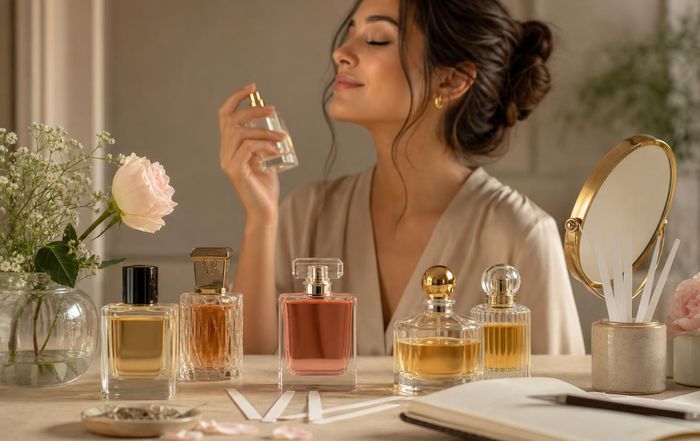
A signature fragrance becomes more meaningful when it is integrated into daily rituals rather than sprayed on as an afterthought. The moment of applying perfume can be a brief act of mindfulness, a cue to check in with how you want to show up that day. Placing your bottle near where you get dressed or where you keep your skincare can turn it into a natural part of your morning or evening routine. This aligns with broader practices of intentional living and mindfulness, where small, repeated gestures accumulate into a sense of groundedness.
Application technique matters. Spraying onto pulse points-wrists, inner elbows, behind the ears, the base of the throat-allows body heat to gently diffuse the scent. Some prefer a light mist in the air and then walking through it for a more diffused effect on hair and clothing, though direct spraying on delicate fabrics should be tested carefully to avoid staining. Layering with unscented or lightly scented body lotion can help a fragrance last longer and project more evenly, something many beauty experts and dermatologists note when discussing skin hydration and scent longevity on sites such as https://www.aad.org/.
Fragrance can also support emotional wellbeing. Certain notes, like lavender and citrus, have been studied for their potential calming or uplifting effects, and institutions such as Johns Hopkins Medicine at https://www.hopkinsmedicine.org/ discuss how smell influences mood and stress. While perfume is not a substitute for therapy or medical care, it can complement broader self-care practices: a soft, familiar scent on difficult days; something bright and sparkling when motivation is low; a sensual fragrance when reconnecting with your body after periods of stress or burnout. Thinking of perfume as part of your personal toolkit for resilience and confidence can shift it from a luxury to a meaningful, if still pleasurable, investment.
When your nose says yes: deciding, buying, and caring for your scent
Eventually, you will encounter a fragrance that feels uncannily right: it sits comfortably on your skin, fits your lifestyle, and sparks a feeling of recognition or aspiration. Before purchasing a full bottle, it is still wise to wear it several times in different contexts-busy days, quiet evenings, varying weather-using samples or travel sizes if available. This helps ensure you are not just reacting to novelty or a single good mood. Beauty and consumer organizations, as well as major retailers, often provide guidance on sampling and returns, and consumer advice hubs such as https://www.consumerreports.org/ can offer general tips on making thoughtful beauty purchases.
Once you commit, caring for your fragrance will prolong its life and maintain its character. Perfumes are sensitive to light, heat, and air, which can cause the aromatic compounds to break down. Storing bottles upright in a cool, dry, and relatively dark place-such as a cupboard or drawer rather than a steamy bathroom-can help preserve them. Keeping the cap tightly closed and avoiding frequent decanting minimizes oxidation. Most fragrances remain stable for several years if stored well, though slight color changes over time are not always a sign of spoilage; your nose is the best judge.
As months and years pass, your taste may evolve. Major life transitions-career changes, moves, relationships, health shifts-often reshape how women want to feel in their own skin. It is perfectly normal to retire a former signature fragrance, gift it to someone who loves it, or keep it only for occasional nostalgia. Revisiting the reflective steps that helped you choose in the first place-personality, lifestyle, memories, and mood-can guide you again. Exploring new scents can be part of broader personal growth, much like updating your goals, routines, or learning paths, themes often explored on career, business, and education pages.
In the end, the "right" signature fragrance is the one that makes you feel more fully yourself, not the one that earns the most compliments or aligns with a trend list. By slowing down, learning a bit of the language, testing thoughtfully, and honoring your own body and context, you can choose a scent-or a small, intentional wardrobe of scents-that quietly supports the woman you are and the one you are becoming.
