
How to Read Nutrition Labels Without Falling for Marketing
Food packaging is designed to grab attention first and earn trust second. Health claims, bright colors, and buzzwords like "natural," "high protein," or "immune support" can make almost anything look like a smart choice. Yet the only part of the package that is tightly regulated in most countries is the nutrition label and ingredients list. Learning to decode those small panels is one of the most powerful skills for anyone who wants to eat well, support long-term health, or simply feel more in control of what goes into their body.
This guide walks through the key parts of a nutrition label, shows how marketing tries to distract from less flattering details, and offers practical strategies for comparing products quickly in real life. While labelling rules vary between regions, the core principles here apply broadly across major markets such as the United States, United Kingdom, European Union, Canada, and Australia.
Start with the ingredients list, not the front of the pack
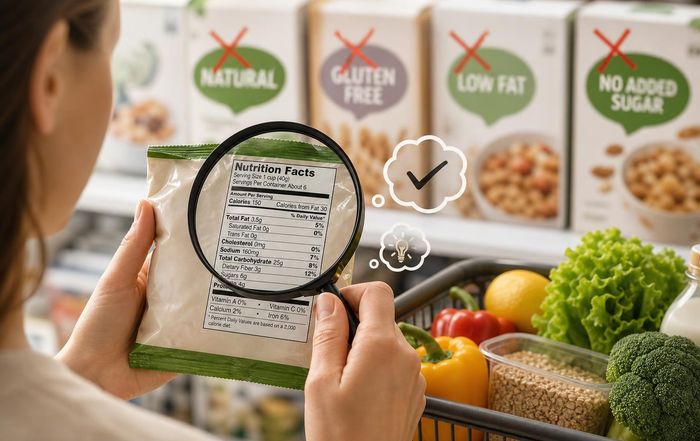
The front of the package is essentially an advertisement. Phrases like "multigrain," "made with real fruit," or "no added sugar" may have some truth behind them, but they are selectively highlighting what looks good and downplaying what does not. The legally meaningful information lives on the back or side: the ingredients list and the nutrition facts panel.
Ingredients are typically listed in descending order by weight. That means the first three to five ingredients tell most of the story. If sugar, refined flour, or cheap oils dominate that list, the product's health halo on the front is likely misleading. When whole foods such as oats, beans, vegetables, or recognizable grains appear first, you are usually looking at a better baseline.
Global food regulators such as the U.S. Food and Drug Administration (FDA), European Food Safety Authority (EFSA), Health Canada (canada.ca), and Food Standards Australia New Zealand (foodstandards.gov.au) all require this descending order format, precisely because it gives consumers a clearer picture of what they are actually buying. For women trying to support better energy, gut health, or hormone balance, this simple habit-turning the product around and scanning the first line or two of ingredients-often matters more than any front-of-pack claim.
People interested in broad lifestyle shifts will also find it useful to pair label literacy with bigger-picture guidance on health and food choices, rather than focusing on individual "good" or "bad" products.
Understand serving size tricks and how they distort the numbers
One of the most common ways labels can mislead-without breaking any rules-is through serving size. Nutrition information is usually presented "per serving," and manufacturers have some flexibility in defining what a serving is. If a snack bag looks like a single portion but lists two or three servings, the calories, sugar, sodium, and fat you are likely to eat in one sitting are much higher than the numbers suggest at first glance.
Regulators such as the FDA and Health Canada have updated serving size rules in recent years to make them more realistic, but there is still room for interpretation. A 600 ml bottle of sweetened iced tea, for example, may define a serving as 250 ml, making the sugar content look modest at a glance. The same pattern appears in cereals, granola, and ready-made meals: small serving sizes can make a high-sugar or high-sodium product appear more reasonable.
A practical way to cut through this is to mentally convert everything to "per 100 g" or "per 100 ml" when possible. In the European Union and many other regions, labels are required to show this standardized value, which makes product comparisons much easier. In markets where this is optional, you can still calculate it quickly: if something has 10 g of sugar per 40 g serving, that equals 25 g of sugar per 100 g. Doing this once or twice for the foods you eat often-granola, yogurt, sauces-can be eye-opening and help you align your choices with your health, fitness, or self-improvement goals.
Sugar: learn all its names and where it hides
Sugar is one of the most heavily marketed and heavily disguised ingredients on labels. Public health bodies like the World Health Organization (WHO) and Public Health England (gov.uk) recommend limiting free sugars to around 10% of total energy intake, with a conditional suggestion to aim for 5% for additional health benefits. For many adults, that works out to no more than 25-50 g of added sugar per day.
To assess sugar on a label, there are three key questions:
How much total sugar is there per 100 g or per realistic portion?
How much of that is "added" sugar versus naturally occurring (for example, from fruit or milk)?
Where does sugar appear in the ingredients list, and under what names?
In some jurisdictions, such as the United States and Canada, "added sugars" must be listed separately on the nutrition panel. In others, only total sugars are shown, so you must rely more on the ingredients list. Sugar may appear as sucrose, glucose, fructose, high-fructose corn syrup, dextrose, maltose, cane sugar, agave, honey, fruit juice concentrate, malt syrup, and many more. When several of these appear in the middle of the ingredients list, the product may contain significant sugar even if "sugar" itself is not the first item.
"Fruit-flavored" or "made with real fruit" claims can be particularly confusing. A yogurt or cereal bar may contain a tiny amount of fruit but rely mainly on sugar or fruit juice concentrate for sweetness. If sugar (or any of its aliases) appears before the actual fruit in the ingredients list, the marketing story on the front is not the full picture.
For readers interested in overall wellbeing, it can be helpful to view sugar not as something to fear but as a nutrient to consciously budget, in the same way you might plan career time or financial resources. Using labels to understand your baseline intake is the first step.
Fats: look beyond "low fat" and "cholesterol free"
Fat on labels has a complicated history. For years, "low fat" was marketed as synonymous with healthy, especially to women concerned about weight. As a result, many products stripped out fat and added sugar or refined starch to maintain taste and texture. Current guidance from organizations such as the American Heart Association (heart.org) and NHS in the UK (nhs.uk) emphasizes the type of fat over the total amount.
When reading labels, it helps to distinguish:
Saturated fat: Found in animal products, some plant oils (such as coconut and palm), and many ultra-processed foods. High intakes are linked with increased LDL ("bad") cholesterol for many people.
Unsaturated fat: Including monounsaturated (olive oil, nuts, avocado) and polyunsaturated fats (fatty fish, some seeds). These are considered more heart-friendly when they replace saturated fats.
Trans fats: Industrially produced trans fats are strongly associated with cardiovascular risk. Many countries now restrict or ban them, but partially hydrogenated oils can still appear in some markets.
A "cholesterol free" claim can be misleading if the product is plant-based anyway (plants do not contain cholesterol) or if it is high in saturated fat or refined carbohydrates. Similarly, a "low fat" dessert may contain high levels of sugar. A more useful approach is to look at saturated fat per 100 g and consider how often and how much you eat of that product, within your overall diet.
If you are navigating specific health concerns-such as heart disease risk, PCOS, or perimenopause-discussing label reading with a healthcare professional or a registered dietitian can add tailored context. Many professional associations, including the Academy of Nutrition and Dietetics (eatright.org) and national heart foundations, offer accessible guides that complement what appears on packages.
Protein and fiber: spot when "high" is actually modest
High-protein and high-fiber claims have become a major marketing hook, especially in snacks, breakfast foods, and products aimed at women interested in fitness or weight management. Yet the actual numbers on the back often do not live up to the bold type on the front.
For protein, consider both the absolute amount and the portion size. A cereal boasting "added protein" might contain only 5-7 g per serving, which is modest compared with a serving of Greek yogurt, eggs, or legumes. Some regions have legal thresholds for "source of protein" or "high protein" claims, typically based on the percentage of energy from protein, but these thresholds are not always aligned with what many people think "high" means in practice.
Fiber claims can be even more confusing. Public health agencies such as the U.S. Department of Agriculture (usda.gov) and EFSA encourage adults to consume around 25-30 g of fiber per day, yet many people fall short. A granola bar with 3 g of fiber may legitimately label itself as a "source of fiber" according to local regulations, but that does not make it a major contributor to your daily target. Looking at fiber per 100 g or per realistic portion helps you compare cereals, breads, or snacks more meaningfully.
One practical rule of thumb: if you are choosing between similar products (for example, two breakfast cereals), favor the one with more fiber and protein and less added sugar, provided the ingredients list still looks reasonable. Over time, these small, repeated choices can support better energy levels and satiety, and complement broader lifestyle and health changes.
Sodium and "reduced salt" claims: why the numbers matter
Salt is another area where marketing language can soften the reality. Terms like "lightly salted" or "reduced sodium" are relative-they compare the product to a previous version or a reference food, not to an ideal target. A "reduced sodium" soup may still be high in salt from a cardiovascular perspective; it is simply lower than the brand's original recipe.
The WHO and many national health agencies recommend limiting sodium intake to around 2,000 mg per day (roughly 5 g of salt), though exact guidelines vary. Processed foods-breads, sauces, snacks, ready meals-are major contributors. When reading labels, pay attention to sodium per 100 g and per portion. Products with more than about 500-600 mg of sodium per 100 g are typically considered high in many guidance systems, while those with 120 mg or less per 100 g are often classed as low.
If you regularly rely on convenience foods because of time pressure, caregiving responsibilities, or demanding work, it can help to identify lower-sodium staples in each category you buy frequently: tomato sauce, broth, crackers, frozen meals. Choosing slightly lower-sodium options across multiple items often has more impact than obsessing over a single product.
Buzzwords and health halos: how marketing shapes perception
Beyond the numbers, labels are full of words that create a "health halo," suggesting that a food is better for you than it may actually be. Some of these terms have regulated meanings; others are vague or purely marketing language. Understanding the difference helps you avoid being steered by branding rather than facts.
Common examples include:
"Natural" or "all natural": In many countries, this term is loosely defined or not legally defined at all. A product can be "natural" and still be high in sugar, salt, or refined starch.
"Organic": This is usually a regulated term and must meet specific standards set by bodies such as the USDA or European Commission. Organic status tells you about how ingredients were grown, not about sugar, salt, or calorie content.
"Gluten-free": Essential for people with celiac disease or medically diagnosed gluten sensitivity, but not inherently lower in calories or sugar. Gluten-free snacks can be as ultra-processed as their conventional counterparts.
"No added sugar": This means no sugar was added as an ingredient, but the product may still be high in natural sugars (fruit juice concentrates, dates) and very energy dense.
"Light" or "lite": May refer to reduced fat, reduced sugar, or even just lighter color or flavor. Regulations vary; always check what is actually reduced on the nutrition panel.
Front-of-pack symbols and ratings-such as traffic-light systems, star ratings, or Nutri-Score in parts of Europe-can provide quick guidance, especially when time is short. However, they are based on algorithms that weigh different nutrients and may not fully reflect individual needs, cultural food patterns, or specific health conditions. Using them as a starting point, then verifying with the detailed label, strikes a better balance between convenience and informed choice.
Ingredients order, additives, and ultra-processed foods
There is growing interest in how "ultra-processed foods" affect health, beyond individual nutrients like sugar or fat. Research summarized by organizations such as the World Health Organization and national public health agencies suggests high intakes of heavily processed foods are associated with higher risks of obesity and some chronic diseases, although the science is still evolving and mechanisms are debated.
From a label-reading perspective, ultra-processed foods often have:
Long ingredients lists with many items that would not be used in a home kitchen.
Multiple sweeteners, flavor enhancers, colorings, or texturizers.
Refined flours, modified starches, and cheap vegetable oils near the top of the list.
Not all additives are harmful; many, such as vitamin fortification, can be beneficial. Regulatory agencies like the European Food Safety Authority and FDA evaluate additives for safety and set acceptable daily intakes. However, if a product's ingredients list reads more like a chemistry set than a recipe, it is a signal that this food is far from its original whole-food form.
For many women balancing health, work, and family, the goal is not to eliminate all processed foods-often unrealistic and unnecessary-but to notice patterns. If most of your daily calories come from foods with short, recognizable ingredients lists, occasional ultra-processed items are less of a concern. Combining label literacy with broader mindfulness around eating can help you find a sustainable middle ground rather than chasing perfection.
Practical shortcuts for real-life shopping
Reading every line on every label is not feasible for most people, especially if you are shopping after work, managing children, or squeezing errands into a packed schedule. A few shortcuts can make label reading more realistic:
First, identify your "high-impact" categories-foods you eat daily or in large quantities, such as breakfast items, bread, plant-based milks, yogurt, or snacks you keep at your desk. For these, it is worth comparing several brands in detail once, then sticking with your preferred option. Second, create personal red flags: for example, cereals with more than 10-12 g of sugar per 100 g, or ready meals with more than 600-700 mg of sodium per portion. These numbers will vary depending on your health needs, but having rough thresholds simplifies decisions. Third, use standardized values (per 100 g or 100 ml) as your default comparison, especially for similar products. This sidesteps serving size manipulation and makes it easy to see which option is genuinely lower in sugar or higher in fiber.
It also helps to remember that labels are tools, not moral judgments. Some days you may prioritize convenience or comfort over optimal nutrition, and that is part of a realistic lifestyle. The aim is not to scrutinize every bite, but to gradually shift your routine purchases in directions that better support your long-term health, energy, and goals.
When to seek expert guidance!
For many people, basic label literacy is enough to make meaningful improvements. However, there are situations where professional support can be especially valuable. If you are managing conditions such as diabetes, kidney disease, celiac disease, food allergies, or cardiovascular risk, the details on labels-total carbohydrates, specific allergens, sodium, potassium, types of fat-can have medical implications. In these cases, working with a registered dietitian or qualified nutrition professional, ideally one affiliated with a reputable organization such as the Academy of Nutrition and Dietetics or your national dietetic association, can help you interpret labels in light of your specific needs.
Similarly, if you find that reading labels triggers anxiety, guilt, or disordered eating patterns, it may be worth exploring a more flexible approach with a clinician experienced in intuitive or mindful eating. Nutrition information is meant to be empowering, not overwhelming. Combining factual skills like label reading with broader support around self-improvement and mental health can help keep food in its rightful place-as one important part of a full life, not the center of it.
Using labels to support your own definition of "healthy"
There is no single perfect way to eat that fits every woman, every culture, and every stage of life. Athletic training, pregnancy, perimenopause, demanding caregiving roles, and financial realities all shape what "healthy" looks like in practice. Nutrition labels are not there to dictate your choices, but to give you clearer information so you can align what is on your plate with what matters most to you.
Over time, a few consistent habits-turning the package around, scanning the first few ingredients, checking sugar, fiber, fat type, and sodium in realistic portions-become almost automatic. Combined with broader guidance on health, food, and women's lives, they allow you to see past marketing and make decisions that respect both your body and your circumstances.
The next time a product promises to be "guilt-free," "light," or "packed with goodness," pause before believing the front. The real story is almost always printed in smaller type on the back-and once you know how to read it, the power shifts back to you.
