
Meal Prep for One Without Food Waste: A Practical Guide
Cooking for one can feel like a constant trade-off between convenience, cost, and the guilt of throwing away wilted produce or leftovers that never got eaten. Many solo cooks love the idea of meal prep, but traditional "Sunday batch cook" advice-giant casseroles, family-size packs of chicken, bulk bags of vegetables-often leads to boredom, over-eating, or a fridge full of forgotten containers. For women juggling work, study, caregiving, social lives, or all of the above, the goal is not just efficiency; it is also about caring for health, budget, and the planet.
Designing a meal prep system specifically for one person requires a slightly different mindset. Instead of cooking enormous quantities of a single dish, it is about planning flexible building blocks, buying just enough, storing food smartly, and understanding how to use every last bit. This guide brings together nutrition, sustainability, and time-management strategies to help solo cooks prep confidently with minimal food waste and maximum satisfaction.
Rethinking Meal Prep When You Live Alone
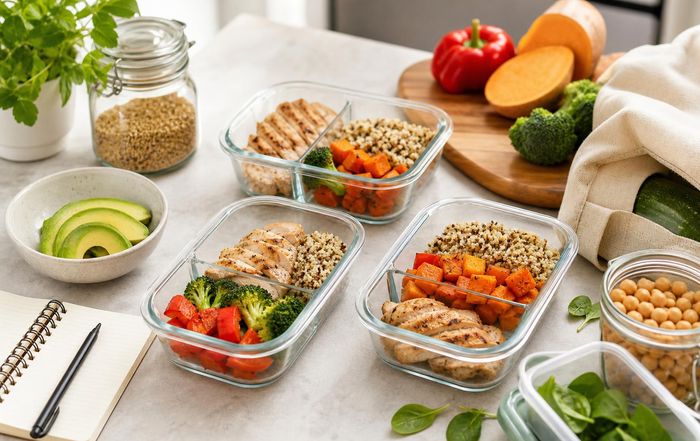
Traditional meal prep advice often assumes a household of several people: big pans of lasagna, multiple trays of chicken breasts, and huge pots of chili. When only one person is eating, that approach can quickly turn into repetition fatigue, overeating to "avoid waste," or simply throwing things away. Meal prep for one works better when it focuses on components rather than complete, pre-portioned meals for an entire week. Think cooked grains, roasted vegetables, a protein or two, and a sauce that can be recombined in different ways, rather than five identical lunch boxes.
This component-based approach also respects the reality that appetites change during the week. A day of back-to-back meetings, a heavy workout, or a stressful commute can alter what feels satisfying. Leaving some flexibility in your plan lets you respond to your body's hunger and energy needs without abandoning the prep you already did. It can also support more intuitive eating and reduce the pressure to "stick to the plan" at all costs. For readers focused on self-improvement and wellbeing, this can be an important mindset shift away from all-or-nothing thinking around food.
Another major difference for solo meal prep is storage. A small fridge or limited freezer space can make large-scale batch cooking impractical. But even in a compact kitchen, a few well-chosen containers and a clear labeling habit can transform how long food stays appealing. Combining these structural tweaks with a more realistic understanding of your weekly schedule is key. If you know that two nights are usually taken up by social plans or late work calls, you do not need seven dinners prepped in advance; three or four flexible options may be plenty.
Planning: The Foundation of Low-Waste Solo Cooking
The most powerful tool for cutting food waste when cooking for one is not a gadget or a specific recipe; it is planning. That does not mean mapping every bite of the week, but it does mean creating a simple structure that matches your real life. Start by looking at your calendar and honestly blocking out how many meals you will probably eat at home. Include breakfast, lunch, and dinner, but also notice patterns like a weekly team lunch, regular takeout with friends, or evenings you often work late and end up grabbing something on the way home. Overestimating how much you will cook is a common cause of waste.
From there, choose just two or three main "anchors" for the week: for example, a pot of grains, a batch of roasted vegetables, and one versatile protein such as chickpeas, tofu, or chicken. Build a short shopping list around those anchors, adding fresh items that are easy to use up-like salad greens, yogurt, eggs, or fruit that can double as snacks and breakfast. Resources from organizations like the Food and Agriculture Organization of the United Nations at https://www.fao.org/ and national campaigns such as Love Food Hate Waste at https://www.lovefoodhatewaste.com/ provide helpful background on planning and storage techniques that reduce waste at household level.
It can also help to think in "families" of ingredients. For example, if you buy a bunch of cilantro, plan two dishes that use it-maybe a lentil soup and a grain bowl with a quick herb sauce-so the bunch is more likely to be finished. The same logic applies to dairy, bread, and salad greens. Many solo cooks find that planning for four days rather than seven is a sweet spot: prep for the workweek, then reassess on Thursday or Friday based on what is left and what your weekend looks like. This phased planning naturally lowers the risk of forgotten ingredients at the back of the fridge.
Smart Shopping for One: Buy Less, Use More
Once the plan is sketched, shopping becomes the next opportunity to prevent waste. A written list-on paper or in an app-makes it easier to resist impulse buys that will not fit into your week. For women watching both health and budget, this is also a way to align spending with priorities rather than marketing. Several major health agencies, including the World Health Organization at https://www.who.int/, emphasize the role of fruits, vegetables, whole grains, and lean proteins in long-term wellbeing; building a list around these basics helps ensure that what you buy is both nourishing and versatile.
For solo cooks, portion size at the shop matters. Where possible, choose loose produce rather than pre-packed bags so you can buy one pepper, two carrots, or a small handful of green beans. Many supermarkets now offer "wonky" or imperfect vegetables at a discount, which can be ideal for soups, stews, and roasting. Frozen fruits and vegetables are also powerful allies: they are picked at peak ripeness, often cheaper, and you can pour out exactly what you need. Guidance from agencies like the U.S. Department of Agriculture at https://www.usda.gov/ and NHS in the UK at https://www.nhs.uk/ supports the nutritional value of frozen produce as a convenient alternative to fresh.
Another crucial mindset shift is learning to ignore "bulk is always better" messaging. While unit prices for larger packages are often lower, if half of that food ends up in the bin, the true cost per serving skyrockets. For shelf-stable staples you eat frequently-such as oats, rice, or lentils-bulk can make sense, especially if you have space to store them in airtight containers. But for perishable items like salad greens, bread, and dairy, smaller packages or shared purchases with a friend or neighbor are often more sensible. Women living in shared housing or apartment buildings sometimes coordinate informal "pantry swaps" to share bulk items or split large packs, which can be both economical and social.
Batch Cooking Without Boredom
The heart of many meal prep systems is batch cooking, but for one person, the challenge is avoiding monotony. Instead of making a huge quantity of a single dish, consider preparing neutral base components that can be seasoned differently throughout the week. A pot of plain quinoa, brown rice, or whole-wheat couscous can become a salad one day, a warm bowl with roasted vegetables the next, and a side for a quick stir-fry later on. Similarly, roasting a tray of mixed vegetables-such as carrots, onions, peppers, and zucchini-with just olive oil, salt, and pepper creates a flexible building block for wraps, omelets, and grain bowls.
Proteins lend themselves well to this modular approach. A batch of baked tofu cubes, a pot of beans, or a few roasted chicken thighs can be seasoned at cooking time with simple spices, then dressed up later with different sauces: think tahini-lemon one day, soy-ginger the next, pesto or yogurt-herb on another. Nutrition guidance from organizations like the Academy of Nutrition and Dietetics at https://www.eatright.org/ and Harvard T.H. Chan School of Public Health at https://www.hsph.harvard.edu/ highlights the benefits of plant-forward eating, so including legumes, nuts, seeds, and soy can support both health and sustainability.
To keep things interesting, focus on variety in textures and flavors more than on entirely new recipes. Adding crunchy toppings like seeds or toasted nuts, fresh herbs, pickles, or a squeeze of citrus can transform a familiar base. A small "sauce rotation" is particularly powerful: a jar of hummus, a quick homemade vinaigrette, a spoonful of kimchi, or a drizzle of chili oil can give the same ingredients a different personality. This is also where food intersects with creativity and pleasure; meal prep does not have to be austere to be efficient.
Storage Strategies That Actually Work
Good storage extends the life of your food and protects the time you invested in prep. A small collection of containers in different sizes-ideally clear, stackable, and with tight-fitting lids-can make a big difference. Glass containers are durable and reheat well, but high-quality plastic or stainless steel can also work, particularly if you are taking meals to work or school. Labeling containers with the contents and date, even with a piece of masking tape and a pen, reduces the "mystery box" problem that often leads to forgotten leftovers.
Understanding how long different foods keep is another key to reducing waste. Many national food safety agencies, such as the U.S. Food and Drug Administration at https://www.fda.gov/ and the European Food Safety Authority at https://www.efsa.europa.eu/, provide guidance on refrigeration times. As a general rule, cooked grains and proteins last about three to four days in the fridge, while many soups and stews can last slightly longer or be frozen in single portions. To stay within safe time frames, it is often better for solo cooks to freeze a portion of a dish on the day it is made rather than waiting to see whether it will be eaten.
The freezer is an underused ally for single-person households. Freezing half a loaf of bread in slices, stashing single-serve portions of cooked beans, or freezing chopped herbs in olive oil can dramatically cut waste. Even small amounts of leftover vegetables can be saved in a container and later turned into a "freezer soup." For those exploring lifestyle changes, building a habit of freezing rather than discarding can feel like a quiet but meaningful act of environmental responsibility.
Using Every Bit: From Scraps to Second Meals
Minimizing waste is not only about planning and storage; it is also about how ingredients are used. Many parts of vegetables that are often discarded are perfectly edible and nutritious. Broccoli stems can be peeled and sliced into stir-fries, beet greens can be sautéed like spinach, and herb stems can be finely chopped into sauces. Even if you prefer not to eat these parts directly, they can often be simmered into a vegetable stock that forms the base of soups and grains. Environmental organizations such as the United Nations Environment Programme at https://www.unep.org/ and national waste-reduction campaigns stress that these small household choices collectively shape global food waste trends.
Leftover cooked ingredients can also be reimagined rather than simply reheated. A small amount of roasted vegetables can become a frittata with eggs, a topping for toast with a smear of hummus, or the filling for a quesadilla. A single portion of leftover grains can be fried with an egg, some frozen peas, and soy sauce for a quick "fried rice." This kind of improvisation becomes easier with practice and can be a playful way to build kitchen confidence. For readers interested in self-improvement and mindfulness, treating leftovers as a creative challenge rather than a burden can shift the emotional tone of solo cooking.
If you find that certain ingredients repeatedly go to waste-half a tub of ricotta, the last third of a bag of salad, or a few lonely carrots-consider building a short "rescue list" of go-to ideas. For example, salad greens can be quickly sautéed with garlic and olive oil if they start to wilt, cheese can be folded into omelets or stirred into pasta, and carrots can be grated into oatmeal muffins or simmered into soup. Over time, this repertoire becomes second nature and dramatically cuts what ends up in the bin.
Portioning for One: How Much to Prep and Serve
One of the hardest parts of cooking for one is judging quantity. Recipes are often written for four, and halving or quartering them can be awkward, especially for items like eggs. It can help to develop a few visual benchmarks: for example, a cupped hand of dry pasta, half a mug of rice, or a palm-sized portion of protein. Public health resources such as the British Nutrition Foundation at https://www.nutrition.org.uk/ and Dietitians of Canada at https://www.dietitians.ca/ offer portion size guidance that can be adapted to individual energy needs.
When prepping for the week, aim to cook in multiples that divide easily into individual meals-two, three, or four servings rather than five or seven. For example, cooking one cup of dry rice yields about three cups cooked, which can comfortably cover three meals without lingering too long in the fridge. Similarly, roasting four chicken thighs might give you three meals plus one portion to freeze. If a recipe makes more than you want, freeze a portion immediately in a single-serve container labeled with the date. This "cook once, eat twice (or three times)" rhythm supports both convenience and freshness.
It is also worth paying attention to your own hunger cues over time. Some women find they consistently portion too much at dinner and end up overly full or forcing themselves to finish to "avoid waste." Others under-portion and then snack unsatisfyingly later. Treat meal prep as an experiment: note when you feel comfortably satisfied versus overly stuffed or still hungry, and adjust your future portions accordingly. Aligning prep with your body's needs is not only kinder to yourself; it is also a subtle but effective way to reduce waste.
Quick, Flexible Meal Formulas for One
Rather than memorizing dozens of recipes, many solo cooks benefit from a few flexible "formulas" that can be adapted to whatever is on hand. Grain bowls are a classic example: combine a base (rice, quinoa, couscous), a vegetable or two (roasted, steamed, or raw), a protein (beans, tofu, chicken, eggs), and a sauce or dressing. This structure can absorb leftovers easily and works with different flavor profiles, from Mediterranean to Asian-inspired to Latin American.
Another adaptable formula is soup. A simple base of onion, garlic, and a carrot or celery stick sautéed in oil can support almost any combination of vegetables, beans, grains, or small amounts of leftover meat. Stock can be homemade from vegetable trimmings or store-bought, and the whole pot can be portioned into two or three single-serve containers. For readers interested in health and food, soups and stews are a nourishing way to incorporate a variety of vegetables without much fuss.
Egg-based dishes, such as omelets, frittatas, and shakshouka-style baked eggs, are particularly suited to using up small amounts of ingredients. A lone mushroom, a few spinach leaves, or half a roasted pepper can all find a home in an egg dish. Similarly, wraps and quesadillas can turn odds and ends into satisfying meals with the help of a tortilla and some cheese or hummus. These formulas are less about strict recipes and more about patterns, which can help busy women stay fed without constant decision fatigue.
Mindset, Sustainability, and Self-Care
Reducing food waste when cooking for one is not only a logistical puzzle; it is also an emotional and ethical one. Many women feel guilty when they throw food away, particularly in light of statistics from organizations like the World Resources Institute at https://www.wri.org/ and Our World in Data at https://ourworldindata.org/ showing the environmental impact of wasted food. At the same time, life is unpredictable: plans change, energy dips, and sometimes the most sustainable choice for mental health is ordering takeout rather than forcing yourself to cook.
A compassionate mindset recognizes that the goal is progress, not perfection. Each small improvement-planning realistically, freezing leftovers, learning a new "rescue" recipe-adds up over time. For many readers engaged with women's leadership and career growth, reframing meal prep as a form of self-leadership can be powerful. Feeding yourself well, with respect for your time, budget, and values, is a quiet but profound act of self-care.
There is also room for joy and connection in solo meal prep. Sharing surplus food with a neighbor, swapping recipes with colleagues, or inviting a friend over to cook together can transform what might feel like a solitary chore into a social ritual. Exploring new flavors, experimenting with plant-forward dishes, or simply mastering a few reliable favorites can all contribute to a more confident, sustainable relationship with food. Over time, the combination of practical systems and a kinder inner voice makes it entirely possible to meal prep for one with minimal waste-and maximum satisfaction. For more awesome ideas on aligning your everyday routines with your values and wellbeing, you may also enjoy exploring lifestyle, health, and mindfulness features on the site.
